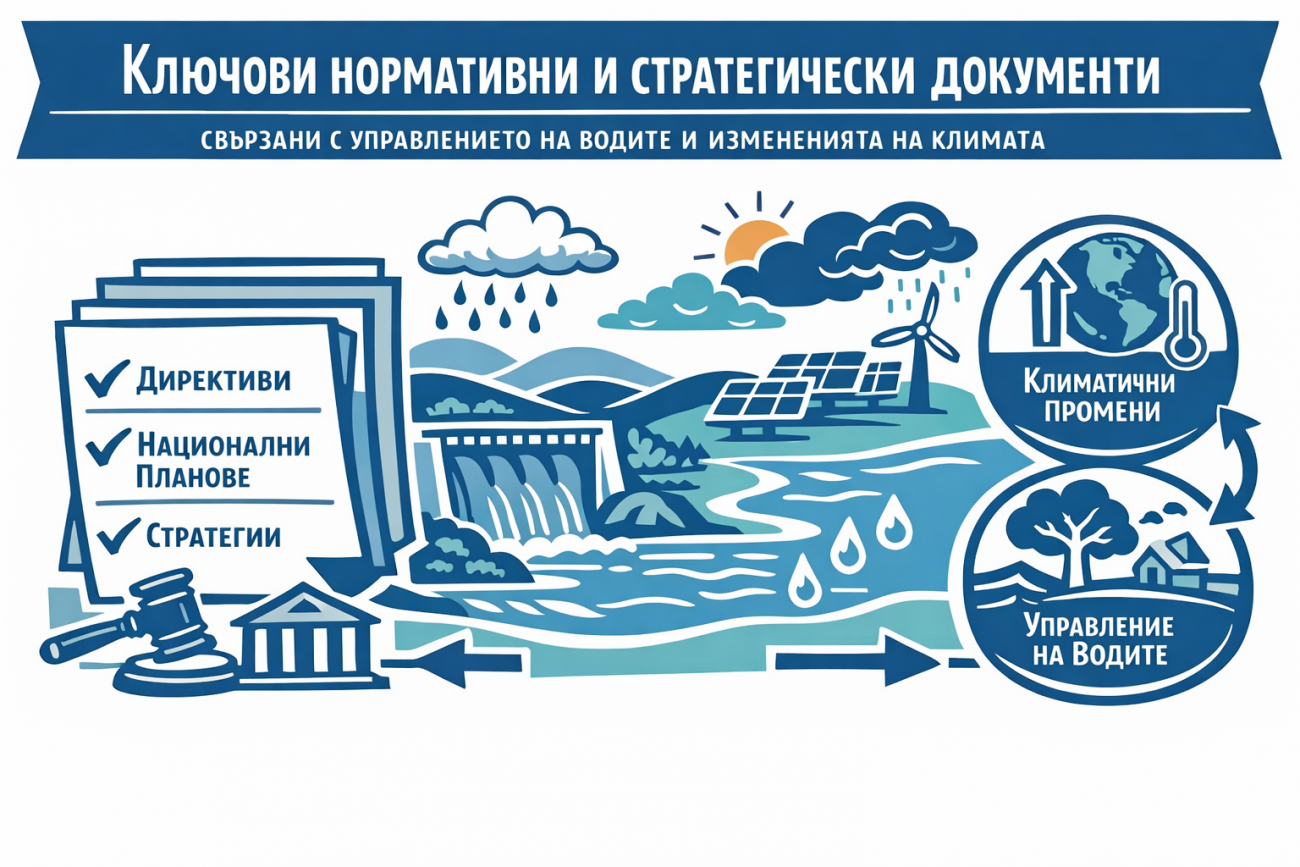
The nationally representative sociological survey of the population conducted within the framework of the project “Bulgaria’s Water Strategies for Transition to a Climate Neutral and Sustainable Society” (LIFE WatClima) reveals a very low level of awareness among respondents regarding key regulatory and strategic documents related to water management and climate change.
The survey results show that the overwhelming majority of respondents are not familiar with any of the listed key documents (including the Water Act; the Act on Regulation of Water Supply and Sewerage Services; the Strategy for Development and Management of Water Supply and Sewerage in the Republic of Bulgaria; the National Strategy for Management and Development of the Water Sector in the Republic of Bulgaria; the Climate Change Adaptation Strategy and Action Plan (up to 2030); the EU Strategy on Adaptation to Climate Change; and the European Green Deal), and this applies across all river basin management regions. The results further show that the main documents related to climate change (the Climate Change Adaptation Strategy and Action Plan up to 2030 and the EU Strategy on Adaptation to Climate Change) are least familiar to the respondents.
These results highlight the need to provide information on the content of these documents, as well as to facilitate access to them in order to support further familiarization by all stakeholders.
As a first step in this direction, brief summaries of the content of each of the above-mentioned key documents related to the water sector and climate change are presented below, along with links to their full texts:
1. Water Act
The Water Act regulates the ownership, management, use, and protection of water as a national natural resource in Bulgaria. It covers both surface and groundwater, defines the regimes for water abstraction, use, and discharge, as well as measures for pollution prevention. The Act introduces a river basin management approach, monitoring and control systems, and defines the powers of public authorities and the obligations of users.
- Water Act (Lex.bg): https://lex.bg/laws/ldoc/2134673412/?utm
- PDF version of the Act:
https://www.damtn.government.bg/wp-content/uploads/zakoni/zakon-za-vodite.pdf
2. Act on Regulation of Water Supply and Sewerage Services
This Act regulates the conditions for the provision, regulation, and control of water supply and sewerage (WSS) services in Bulgaria, including their pricing, quality, and accessibility. A key role is played by the Energy and Water Regulatory Commission (EWRC), which licenses operators, approves tariffs, and monitors compliance with regulatory requirements. The Act aims to protect consumers and ensure the sustainable functioning of the WSS sector.
- Act on Regulation of WSS Services (Lex.bg): https://lex.bg/laws/ldoc/2135499390?utm
- Ministry of Regional Development and Public Works page: https://www.mrrb.bg/bg/zakon-za-regulirane-na-vodosnabditelnite-i-kanalizacionnite-uslugi/?utm
3. Strategy for Development and Management of Water Supply and Sewerage in the Republic of Bulgaria
The Strategy defines the long-term objectives and measures for the development of water supply and sewerage (WSS) infrastructure and services, focusing on improving the quality of water supply, enhancing operator efficiency, and ensuring sustainable resource management. It is part of the efforts to adapt the sector to climate-related challenges and includes investments, modernization, and institutional reforms.
- Draft and information on water strategies:
https://www.mrrb.bg/bg/infrastruktura-br-i-programi/vik/proekt-vodnite-strategii-na-bulgariya-za-prehod-kum-klimatichno-neutralno-i-ustojchivo-obstestvo/?utm
4. National Strategy for Management and Development of the Water Sector in the Republic of Bulgaria
This Strategy is the framework document for the overall development of the water sector (including resources, infrastructure, institutions, and services) with a long-term horizon up to 2037. It includes an analysis of the state of water resources, consumption, and management, as well as an action plan with short-, medium-, and long-term measures. Its main objective is to ensure sustainable, efficient, and integrated water management.
- Full text and related materials:
https://www.moew.government.bg/bg/vodi/strategicheski-dokumenti/nacionalna-strategiya-za-upravlenie-i-razvitie-na-vodniya-sektor-v-republika-bulgariya/?utm
5. Climate Change Adaptation Strategy and Action Plan (up to 2030)
The document sets out the national framework for adaptation to climate change by analyzing the risks and vulnerabilities of key sectors (including water, energy, agriculture, and health). The Strategy formulates objectives, policies, and specific measures to enhance the resilience of the economy and society, as well as mechanisms for monitoring and reporting up to 2030.
- National Climate Change Adaptation Strategy:
https://www.strategy.bg/bg/strategy-documents/1313?utm
6. EU Strategy on Adaptation to Climate Change
The EU Strategy aims to build a climate-resilient Europe by 2050 by improving knowledge on climate risks, strengthening planning, and accelerating the implementation of adaptation measures. It promotes the integration of adaptation into all policies, the development of data and scientific knowledge, and international cooperation.
- EU Adaptation Strategy (Climate-ADAPT):
https://climate-adapt.eea.europa.eu/bg/eu-adaptation-policy/strategy?utm
7. European Green Deal
The European Green Deal is a strategic EU initiative aimed at achieving a climate-neutral economy by 2050. It includes policies for reducing emissions, improving energy efficiency, promoting sustainable transport, advancing the circular economy, and protecting natural resources. The Deal sets an intermediate target of reducing emissions by at least 55% by 2030 and requires deep transformations across all economic sectors.
Green Deal context:
https://www.strategy.bg/files/pc/11203/socialen_plan_za_klimata_versiia_10.pdf?utm


